Can You Take a Handheld Fan on a Plane? 2026 Rules Explained
2026-09-23
GUXON 3C News
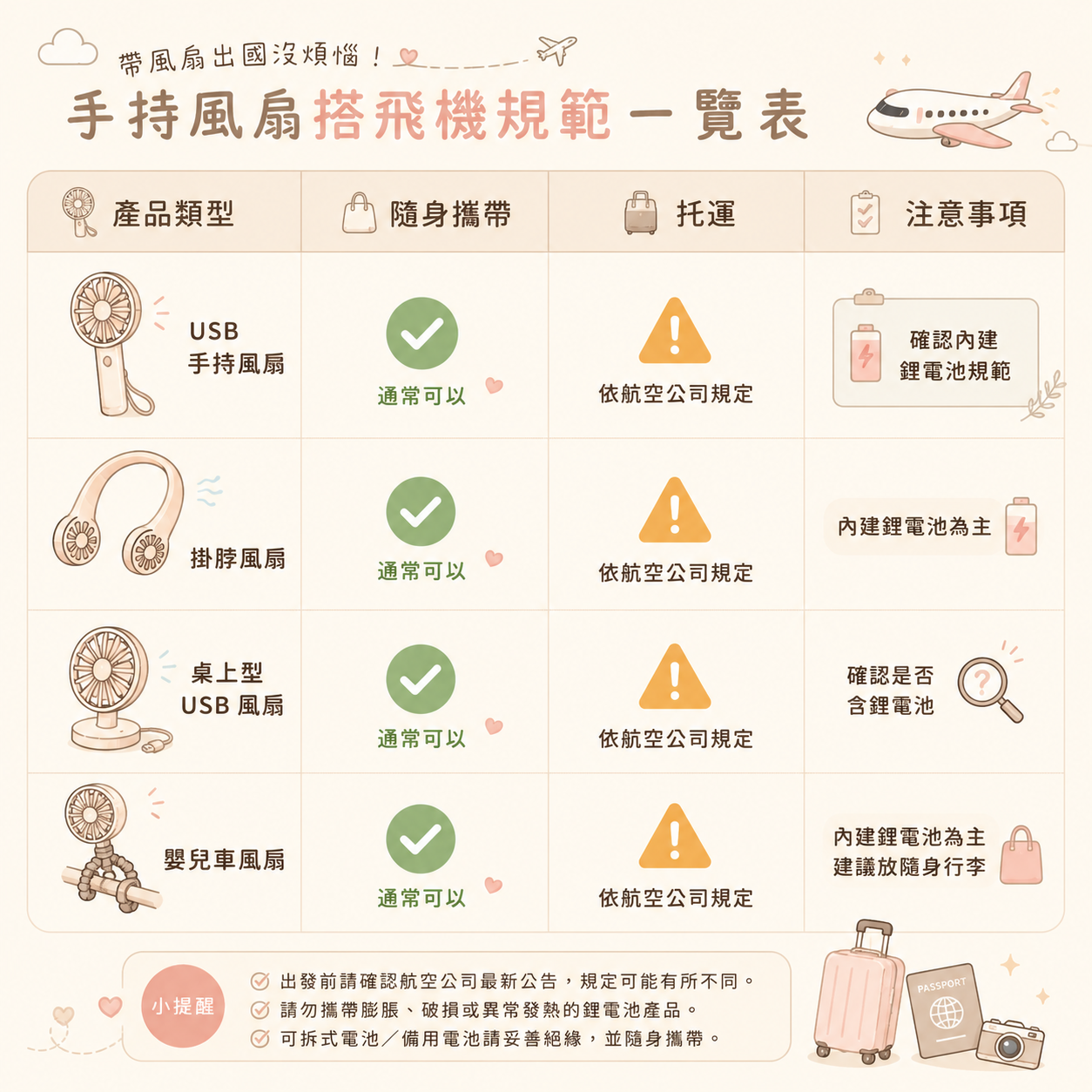
A USB handheld fan, a neck fan or a small desk fan is standard packing for a hot-weather trip. The question that follows is just as standard: can you take a handheld fan on a plane? Can it go in checked baggage? Will security stop it?
This guide walks through the 2026 air safety rules — handheld fans, lithium batteries, checked-baggage limits and what to confirm before you fly.
Taking a handheld fan on a plane in 2026: the full guide
USB handheld fans have become a summer travel staple, and you will see them everywhere on flights to Japan, Korea, Thailand and across Southeast Asia. What airlines actually regulate, though, is not the fan. It is the lithium battery inside it.
Once you understand why airlines regulate lithium batteries, and how the different battery formats are handled, most fans on the market travel without trouble.
What this article covers
✔ Can you take a handheld fan on a plane?
✔ Can it go in checked baggage?
✔ Which lithium-battery products need extra care?
✔ Can you use a fan during the flight?
✔ What should you check with your airline before you go?
The short answers
✈️ Can it fly? An ordinary handheld fan can normally travel in your carry-on.
🔋 What is actually restricted? The lithium battery, not the fan itself.
🛄 Checked baggage? It depends on the airline. Many products are better kept in the cabin.
⚠️ Before you leave: check your airline's current notice, and do not travel with a damaged or swollen lithium battery.
⭐ Airlines regulate the lithium battery, not the handheld fan. As long as the product meets the battery rules and you follow the airline's instructions, most USB handheld fans can travel with you.
✈️ Can you take a handheld fan on a plane?
Yes — provided the lithium battery inside it meets your airline's rules.
It is a common misunderstanding that airlines ban handheld fans. What is regulated is the lithium-ion battery inside the product.
Most USB handheld fans, neck fans and portable fans on sale today use a built-in lithium battery in the 2,000mAh to 5,000mAh range. Converted to watt-hours, that sits well below the thresholds airlines normally apply, which is why the majority of these products can travel in a carry-on.
A note from GUXON: airlines place no specific restriction on "handheld fans". What you need to confirm is whether the lithium battery inside meets the carriage rules.
An ordinary USB handheld fan can usually fly with you.
The lithium battery is the point of concern, not the fan body.
If the battery is removable, spares normally belong in your carry-on.
Checked-baggage rules vary by airline — confirm the official notice before you leave.
🔋 Why do airlines single out lithium batteries?
Nearly every rechargeable device now runs on one: phones, laptops, Bluetooth earbuds, power banks and USB fans alike. Lithium batteries pack high energy density into light weight with long runtime, which is exactly why they became the standard.
The trade-off is that impact damage, a manufacturing fault, a short circuit, heat or abnormal charging can push a cell into thermal runaway — smoke, fire, or worse. That is why ICAO and IATA both set transport rules for lithium batteries, and why individual airlines build their passenger policies on those standards.
💡 Why keep them in the cabin?
If a battery misbehaves in the cabin, the crew can reach it immediately with extinguishing equipment and standard procedures. In the hold, the same event is far harder to deal with. That is the reason spare lithium batteries are normally required to travel in carry-on baggage.
What is Wh, and why does 100Wh keep coming up?
Many airlines do not measure by mAh. They use Wh (watt-hours) to judge how much energy a lithium battery holds. So a product labelled 5000mAh or 10000mAh has to be converted before you can compare it against the rules.
The formula: Wh = (mAh × voltage V) ÷ 1000
A typical lithium-ion cell is rated around 3.7V, which is enough to estimate almost any USB handheld fan.
Common handheld fan capacities converted
Battery capacity
Voltage
Approx. Wh
Flight guidance
2000mAh
3.7V
7.4Wh
✅ Normally permitted
3000mAh
3.7V
11.1Wh
✅ Normally permitted
5000mAh
3.7V
18.5Wh
✅ Normally permitted
10000mAh
3.7V
37Wh
✅ Permitted in most cases
As the numbers show, most USB handheld fans sit far below 100Wh, which puts them inside the lithium-battery rules of most airlines.
Common airline lithium-battery thresholds
Details differ between carriers, but most follow the IATA dangerous goods framework:
Battery capacity
General rule
Under 100Wh
Normally allowed in carry-on, still subject to the airline's own notice.
100–160Wh
Some airlines require approval in advance.
Over 160Wh
Generally not permitted for ordinary passengers.
📌 What GUXON suggests
Check your airline's latest notice before you travel.
Do not carry a lithium-battery product that is visibly damaged, swollen or running unusually hot.
If the battery is removable, insulate spares properly and keep them in your carry-on.
If you are unsure of the specification, read the label on the product or ask the brand's support team for the Wh figure.
Travel Fan|GUXON
Finding the fan that travels well with you. Light, easy to pack, and along for every trip — suited to independent travel in Japan, Korea and Southeast Asia, and to an ordinary summer commute.