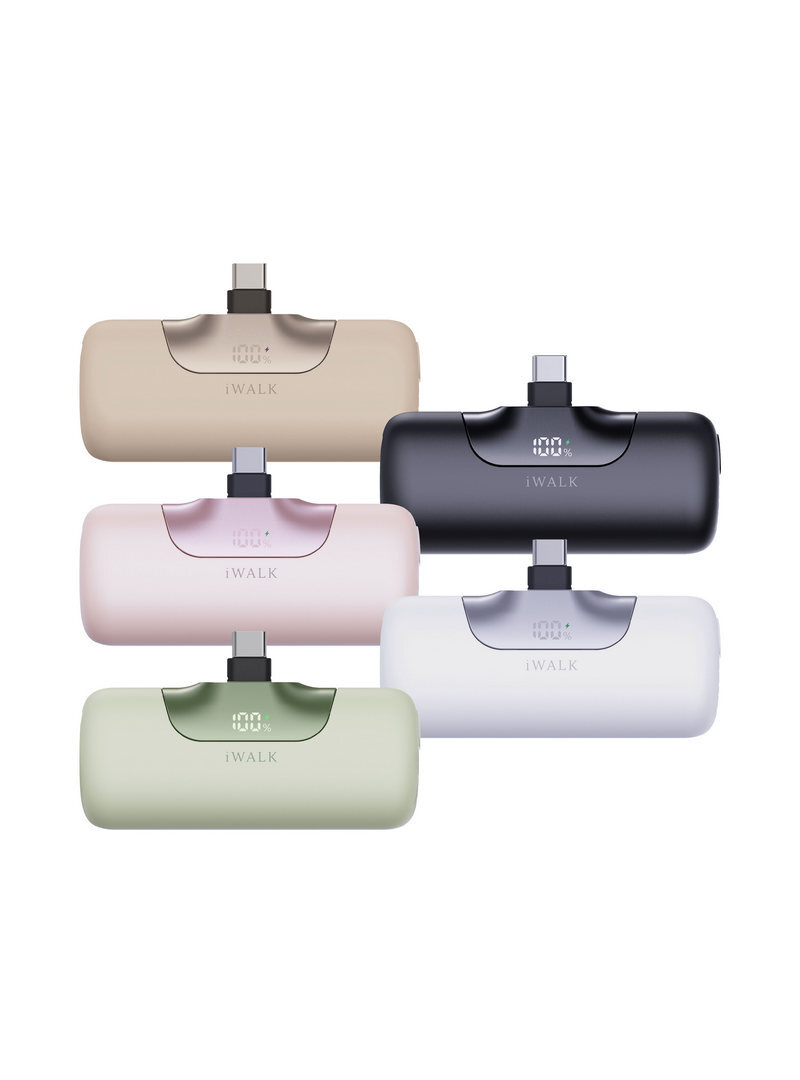
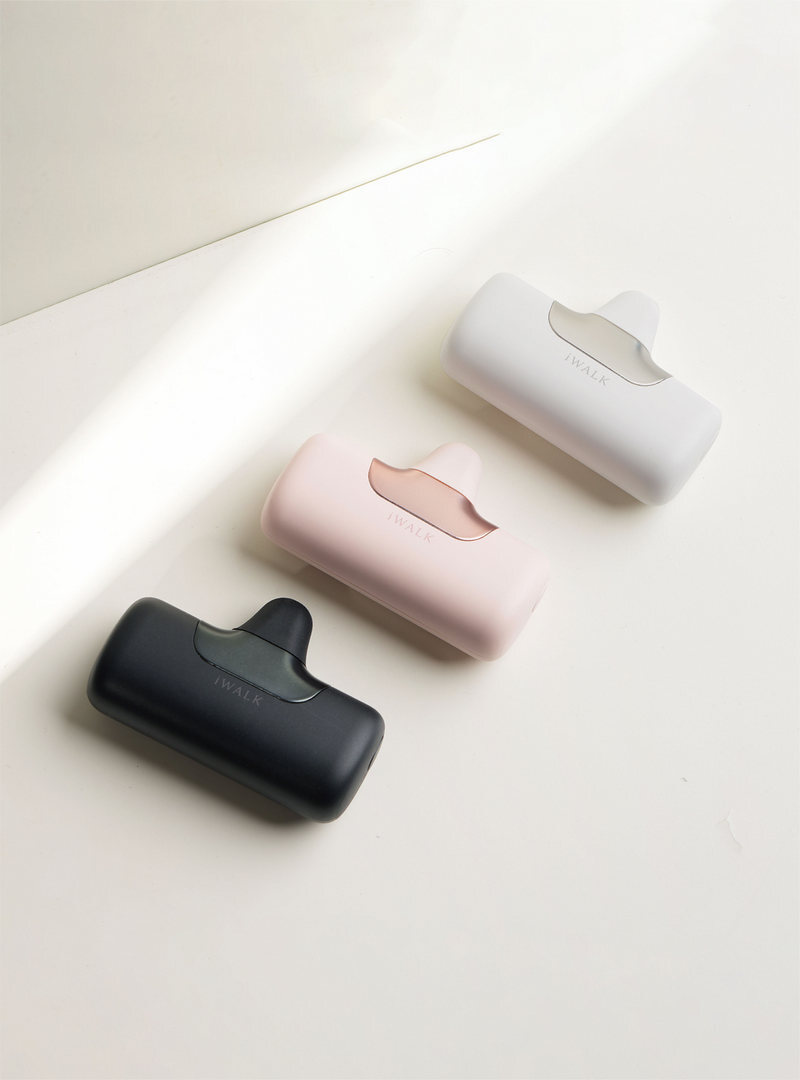
How Many Power Banks Can You Bring on a Plane? 2026 Limit Is Two
2026-09-23
GUXON TRAVEL GUIDE|2026 rules
Can you bring a 10,000mAh or 20,000mAh power bank? How many are allowed, what about checked baggage, and can you use one in flight? Here is the whole picture.
The 30-second version
How many power banks can you bring on a plane in 2026?
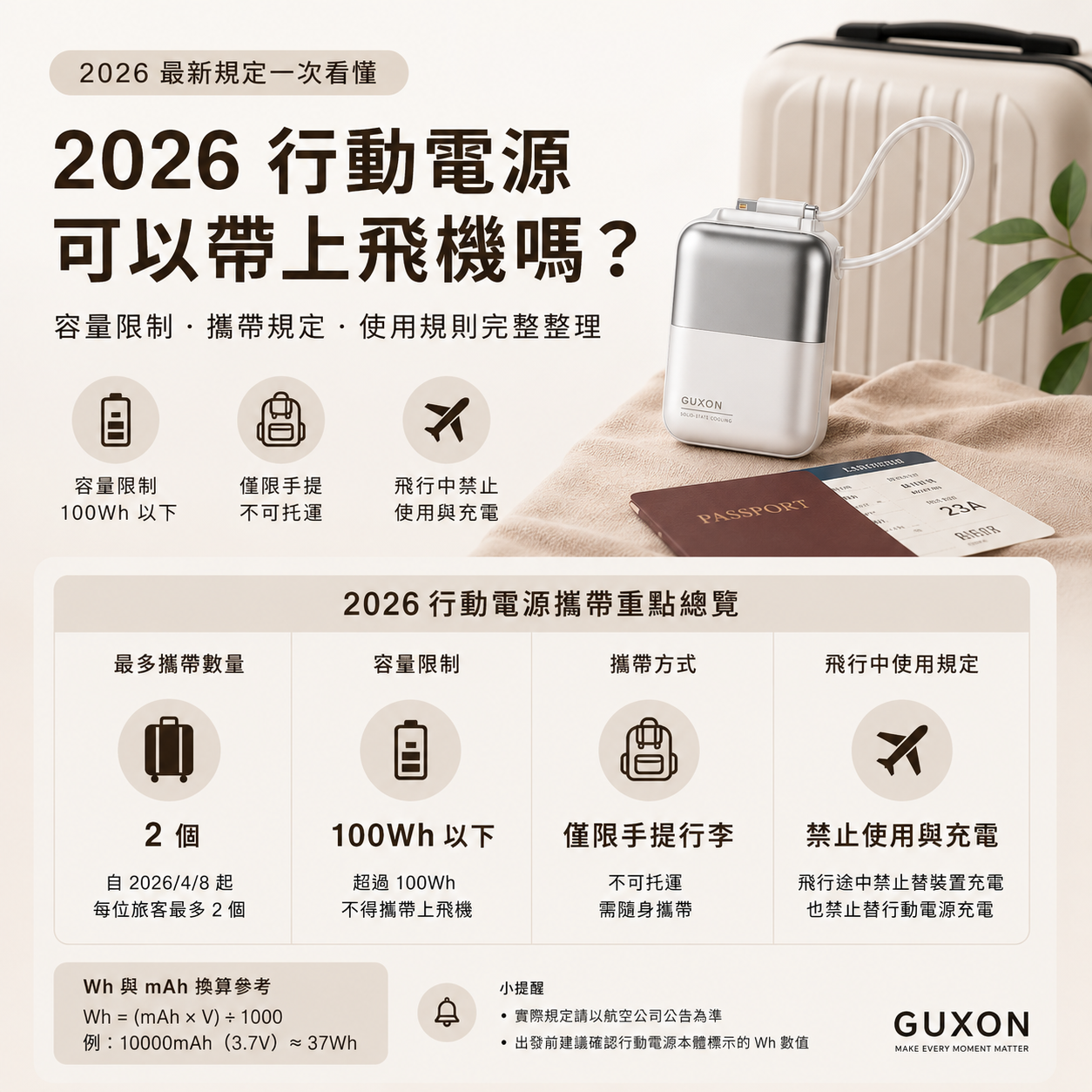
Since 8 April 2026, each passenger may carry a maximum of two power banks.
Power banks cannot go in checked baggage — they must travel in the cabin with you. Using a power bank to charge a phone or other device during the flight is also prohibited, as is charging the power bank itself.
Beyond the two-unit limit, check the product's Wh rating, its physical condition, and the current rules of the airline you are actually flying.
2 — per-passenger limit
Not allowed — in checked baggage
Prohibited — charging during the flight
But "two at most" is not the whole story. Can you bring a 10,000mAh? A 20,000mAh? How much is 100Wh, actually? If you are about to travel, the questions below are the ones that matter.
From 8 April 2026, the number of power banks each passenger may carry is formally limited to two. This is the most significant change to the rules this year.
Passengers already had to follow lithium battery safety rules such as "no power banks in checked baggage". The 2026 change adds a quantity limit on top of that, and explicitly prohibits both using a power bank in flight and charging the power bank itself.
A note from GUXON: "two at most" is a limit on quantity. It does not mean a power bank of any capacity can fly. You still need to check the product's Wh rating.
Can you bring a 10,000mAh or 20,000mAh power bank?
The common 10,000mAh and 20,000mAh sizes are normally below 100Wh. But airline rules are not written in mAh — they use Wh (watt-hours), the figure printed on the product.
So you cannot judge by "10,000mAh" alone. The reliable method is to read the Wh rating on the unit itself.
Common capacity
At 3.7V, approx.
What it means
5,000mAh
18.5Wh
Under 100Wh
10,000mAh
37Wh
Under 100Wh
20,000mAh
74Wh
Under 100Wh
30,000mAh
111Wh
Over 100Wh — check carefully
Converted using a 3.7V nominal cell voltage as an example. Voltages vary between products; when flying, go by the Wh printed on the unit and the airline's current rules.
How much is 100Wh in mAh?
At the common 3.7V cell voltage, 100Wh is roughly 27,027mAh.
That figure is useful for intuition, not for decisions. When flying, do not guess from mAh — read the Wh marking on the product.
The formula: Wh = mAh ÷ 1000 × V
For example: 20,000 ÷ 1,000 × 3.7 = 74Wh
How do you check whether yours can fly?
The fastest way is to read the Wh rating on the body of the power bank. Turn it over, or look at the specification panel, and you will usually find the capacity and Wh printed there.
Can a power bank go in checked baggage?
No. A power bank has to travel as hand luggage, with you in the cabin. It cannot be placed in checked baggage.
Can you use a power bank on the plane?
No. Under the 2026 rules, using a power bank to charge a phone, tablet or other device during the flight is prohibited, and so is charging the power bank itself.
If you are worried about a long flight, charge your devices fully before boarding and use the seat power supply according to your airline's rules.
2026 power banks on planes — the four points
① Two per passenger, maximum
② Not in checked baggage
③ No use during the flight
④ Check the Wh marking before you go
A 30-second pre-flight checklist
✓ No more than two power banks
✓ In hand luggage, not checked baggage
✓ Wh and other specifications clearly marked on the unit
✓ No swelling, damage or other visible faults
✓ Airline's current rules confirmed
✓ No charging during the flight
FAQ
Q1. How many power banks can you bring on a plane in 2026?
Since 8 April 2026, each passenger may carry a maximum of two.
Q2. Can you bring a 10,000mAh power bank on a plane?
A typical 10,000mAh unit is below 100Wh, but check the Wh rating on the product and your airline's rules.
Q3. Can you bring a 20,000mAh power bank on a plane?
At 3.7V, 20,000mAh is about 74Wh, below 100Wh. Again, go by the printed rating and the airline.
Q4. How much is 100Wh in mAh?
At 3.7V, about 27,027mAh. Nominal voltage varies between products, so read the Wh on the unit first.
Q5. Can a power bank be checked in?
No. It must be carried as hand luggage.
Q6. Can you charge your phone from a power bank on the plane?
No. The 2026 rules prohibit using a power bank during the flight, and charging the power bank itself.
Final check
Four things to remember: two at most, never checked, no use in flight, confirm the Wh marking.
If your power bank is on the larger side, or you are flying with carriers in several countries, check each airline's latest notice before you leave.