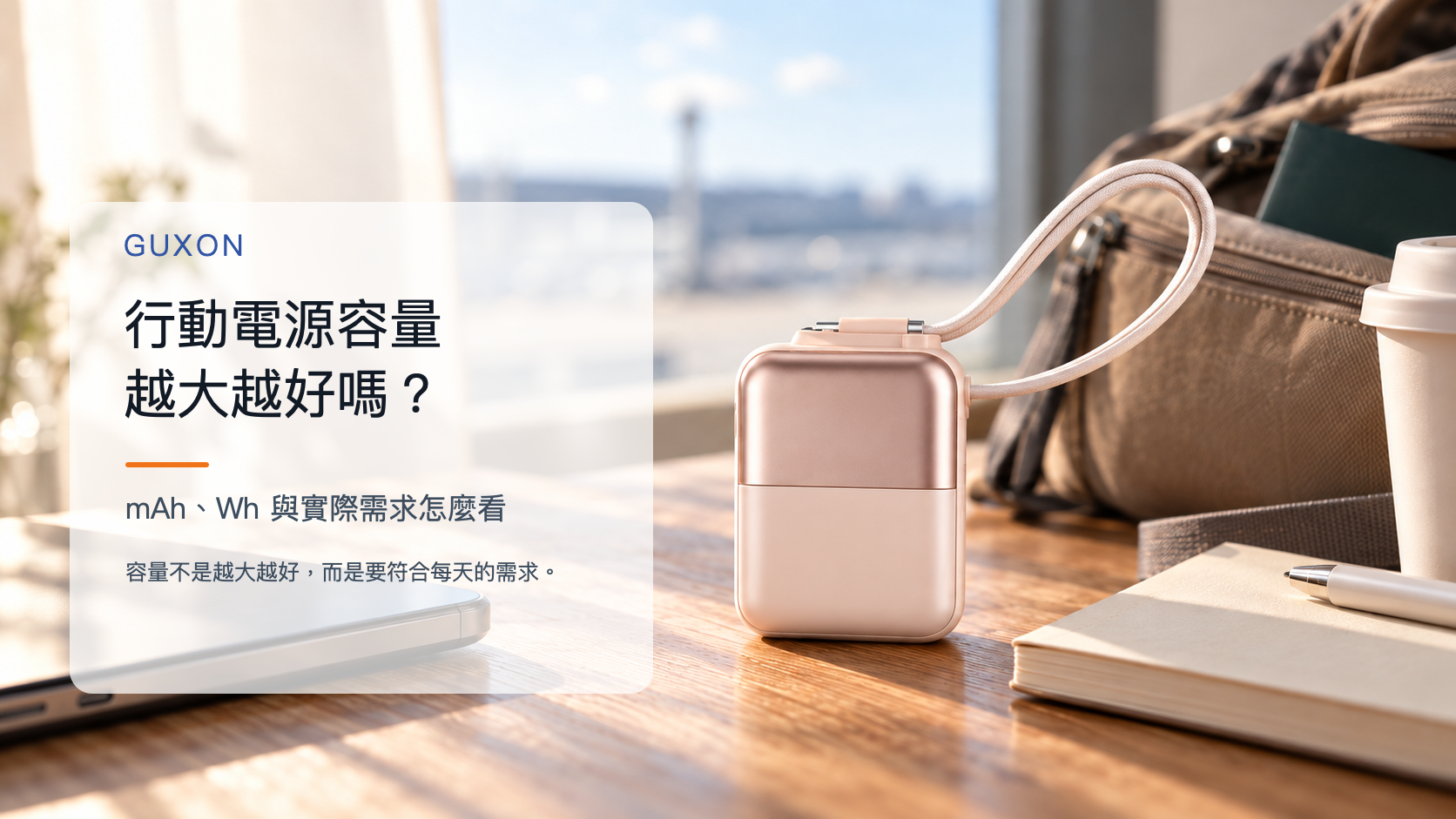
Capacity is usually the first spec anyone looks at when choosing a power bank. 5,000mAh, 10,000mAh, 20,000mAh — the bigger the number, the more spare power you are carrying, so it is easy to read "bigger capacity" as "better buy".
In practice it is not that simple.
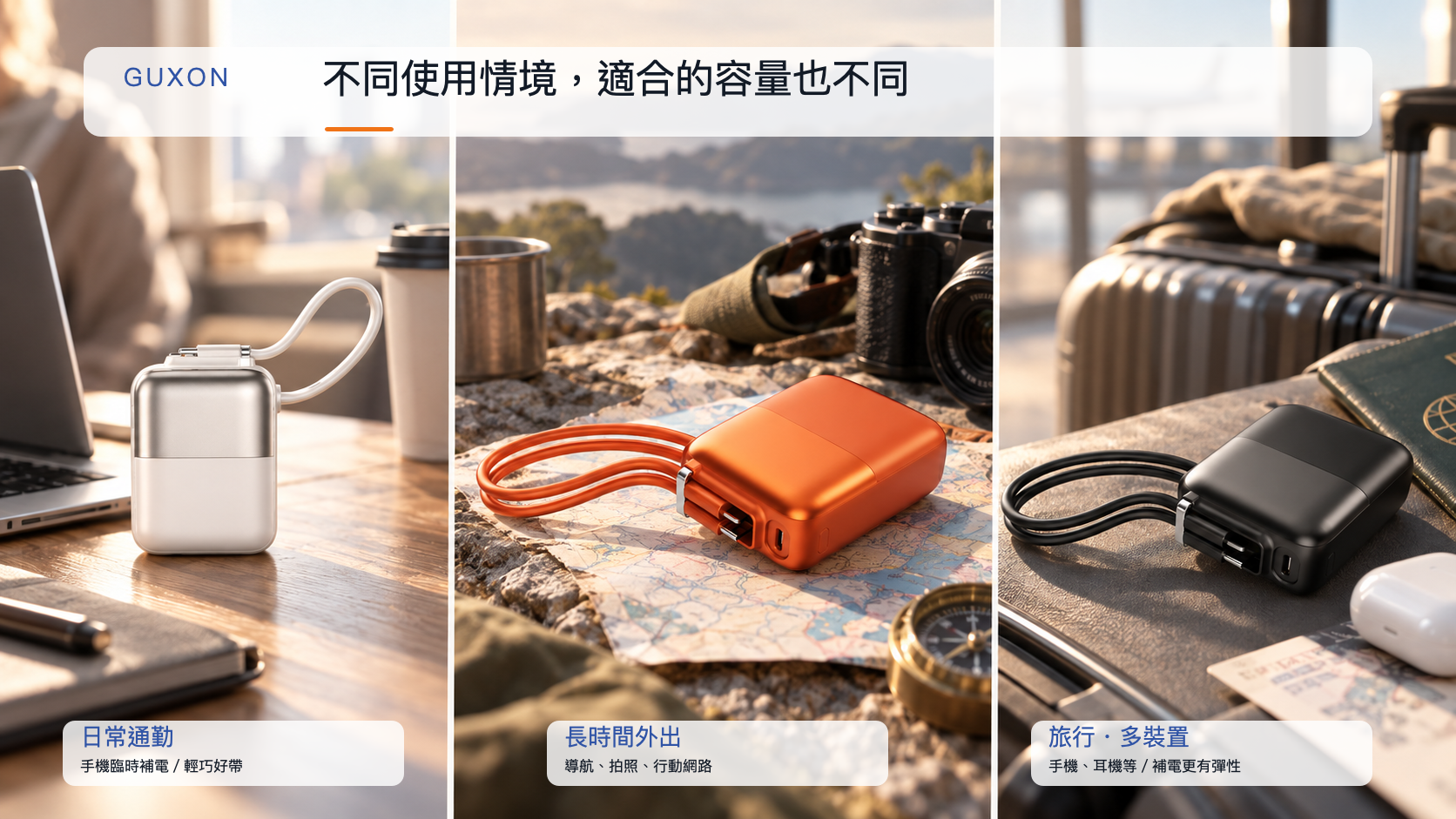
If you are just commuting or out for a few hours, a power bank is only topping your phone up, and excess capacity mostly adds weight. If you are out all day, travelling, or charging a phone, earbuds and a tablet at once, the larger capacity starts to earn its place.
So whether a power bank suits you is not a question of the capacity number alone. It also depends on how long you are out, how you carry it, and how much spare power you actually need in a day.
What is mAh? Reading a power bank's capacity rating
mAh, or milliamp-hour, is the most common way phone and power bank capacity is stated.
For most people its practical use is comparing capacity tiers. A 10,000mAh unit generally offers more spare power than a 5,000mAh one, and that reading is fine.
Where it goes wrong is dividing a power bank's mAh by a phone's battery capacity and treating the result as a full charge count.
Say your phone has a 5,000mAh battery. On paper a 10,000mAh power bank looks like two full charges. In reality there is voltage conversion, charging control and cable transmission along the way, and the phone keeps drawing power while it charges — so the energy that actually reaches the battery is not the same as the rating.
mAh is therefore better for judging capacity tiers than for calculating exact charge counts. To work out how many times a given capacity will actually refill a specific phone, you need the phone model, its battery capacity and conversion efficiency as well.
What is Wh, and why is there a second capacity unit?
Alongside mAh, many power banks also state Wh — watt-hour.
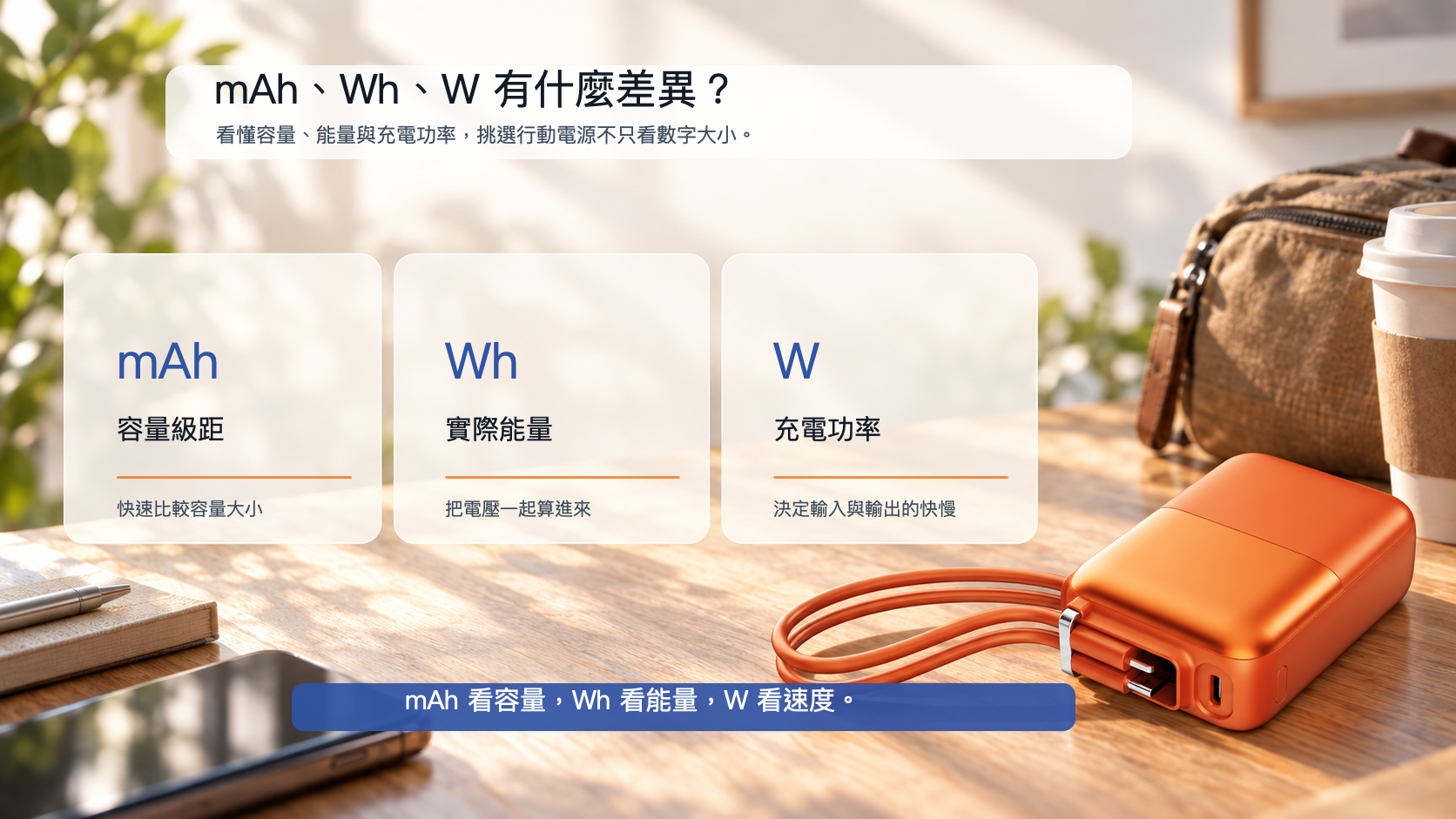
mAh describes battery capacity; Wh folds voltage into the calculation as well, so it describes more completely how much energy a cell actually stores.
The basic conversion is:
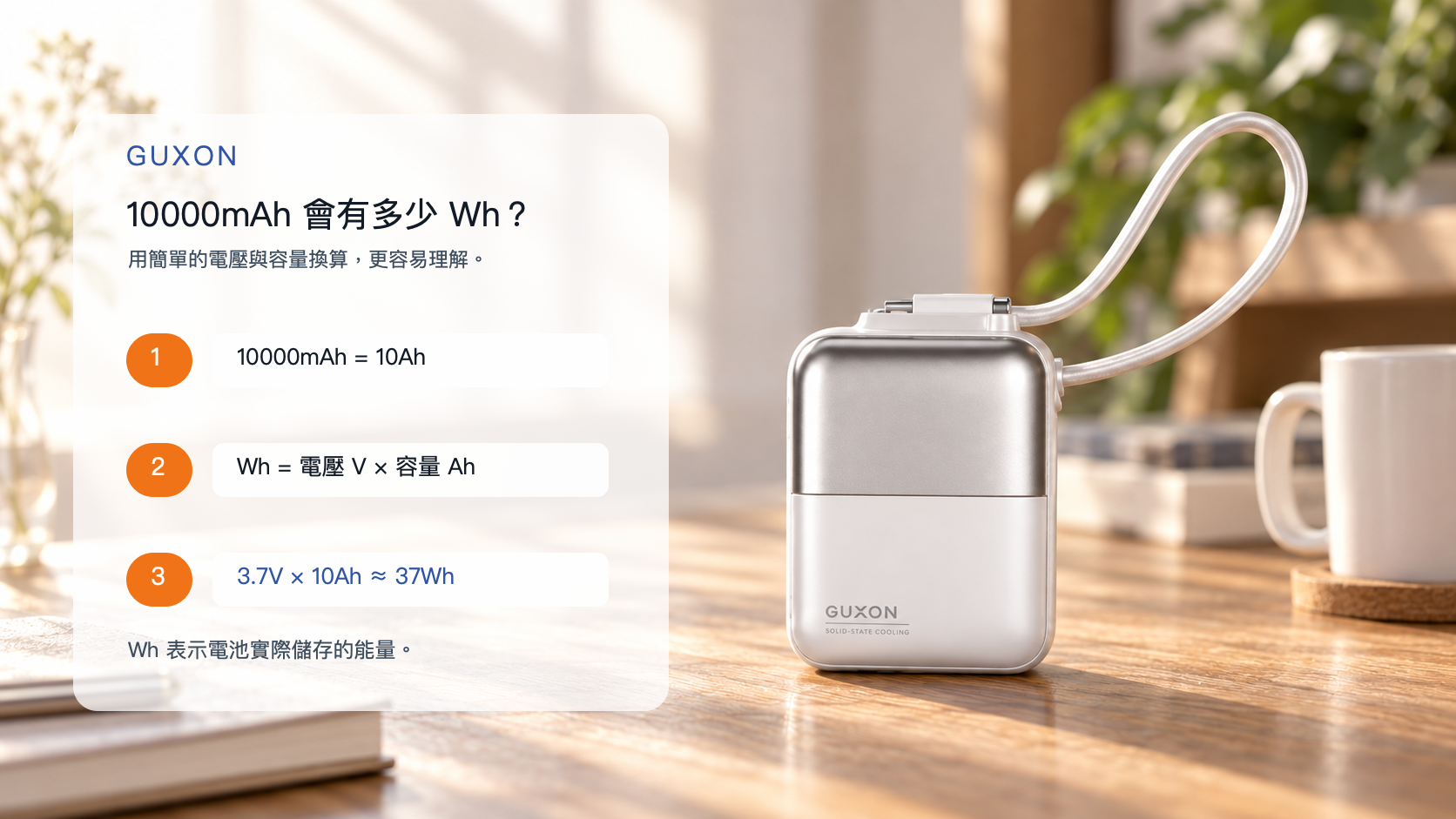
Wh = voltage (V) × capacity (Ah)
A 10,000mAh power bank is 10Ah. If the nominal cell voltage is 3.7V:
3.7V × 10Ah ≈ 37Wh
So that power bank stores roughly 37Wh of energy.
Once Wh makes sense, note that it is not the same thing as the 20W, 30W or 45W you see quoted for fast charging.
W, the watt, describes power at the moment of charging. Wh describes how much energy the battery holds in total.
An everyday way to picture it: W is how fast water comes out of the tap, Wh is how much water is in the tank. A fast tap does not mean a big tank — and a power bank that supports high-wattage fast charging does not necessarily hold a larger battery.
Why Wh keeps coming up when you fly
In aviation lithium battery rules, Wh is the key unit, because it accounts for both capacity and voltage and puts differently specified batteries on the same basis for comparison.
For a 20,000mAh power bank with a nominal 3.7V:
20,000mAh ÷ 1,000 × 3.7V = 74Wh
If you travel often, it is worth checking whether a product states its Wh clearly, not just its mAh.
That said, Wh is only one of the things that matter when judging what you can take on board. Before flying, always confirm capacity limits, quantity, how it must be stored and how it may be used against your airline's and your destination's current rules, rather than relying on how a previous trip went.
Who is 10,000mAh actually right for?
10,000mAh is a very common capacity, but it is not the default answer for everyone.
If your day follows a fixed route and there is charging at home, at the office or in the car, a power bank is mostly there for an unexpected low battery. Something lighter may be enough, and it is less to carry.
If you are out for long stretches using navigation, taking photos and video, or on mobile data, or travelling where sockets are hard to find, it makes sense to keep more in reserve.
Once you go to 20,000mAh or above, weight and bulk need to be part of the decision too.
A power bank is something you physically carry. If the spec looks generous but it ends up living at home because it is too heavy or too thick, the extra capacity never does anything for you.
What else deserves a look besides capacity
Capacity is only one of the criteria.
Output wattage, charging protocols, connector types, cable design, dimensions and weight all shape how you actually use it.
Some people want endurance; others care about a fast top-up in a short window. Some are happy to carry a separate cable; others want the cable built in. Those differences often affect whether you reach for it each day more than another few thousand mAh would.
So before comparing models, work out roughly how much power you need to add in a day, whether you need to charge other devices at the same time, whether you will be carrying it for long periods, and how often you travel. Then find the combination of capacity, weight, charging method and size that fits.
At GUXON, capacity is an important spec — but it should not be the only one you choose on.
mAh helps you understand capacity tiers, Wh tells you the energy stored, and W relates to charging power. Read those together with how you actually spend your day, and it becomes much clearer whether a given power bank suits you.
What capacity really has to solve is not making the number bigger, but having enough power when you need it while keeping the weight, size and handling to something you are willing to carry every day.
Further reading
How many charges will a power bank actually give an iPhone 17?
Usable capacity after conversion losses, and a charge-count table across the iPhone 17 range.
What do airlines check when you fly with a power bank?
Why Wh is the unit that matters, cabin-only carriage, and the 2026 rules across Asia.
How long will a power bank last?
Beyond a single charge, cycle count, usage habits and ageing all affect long-term performance.
References
- International Air Transport Association (IATA) passenger guidance on lithium batteries and power banks
- Airline baggage and lithium battery policies
- Product labelling and battery technical documentation
Aviation rules change over time and by airline. Anything here involving Wh limits, quantities or permitted use should be re-checked against official sources before you travel.