Over the past couple of years you have probably noticed more and more power banks advertising solid-state cells, stacked cells and safer design.
Which raises a fair question: what do these terms actually mean, and are they really safer?
This is not just marketing language. It reflects a real shift in how lithium cells are built.
We used to choose a power bank on capacity and charging speed. Today people increasingly ask:
- Does it run hot?
- Will it swell over time?
- Is it safe to keep in a bag?
- Is it stable under high-power output?
The answers come down to one thing: the internal structure and materials of the cell.
1. Cell structure: wound vs stacked
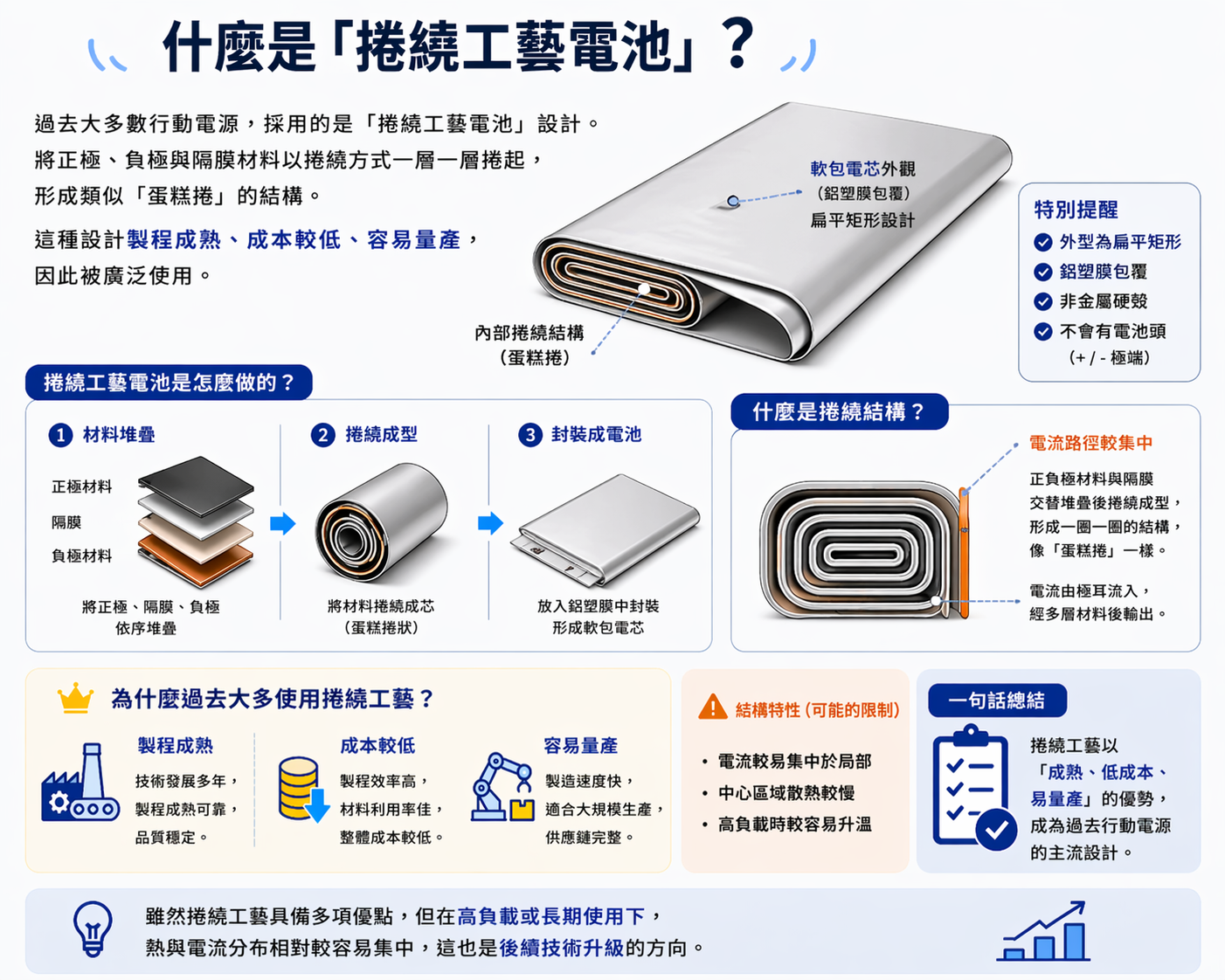
Most power banks have traditionally used wound cells. The cathode, anode and separator are rolled up in layers, rather like a Swiss roll.
The advantages are a mature process, stable manufacturing, lower cost and easy mass production, which is why this design has dominated lithium products for years.

So what is a stacked cell?
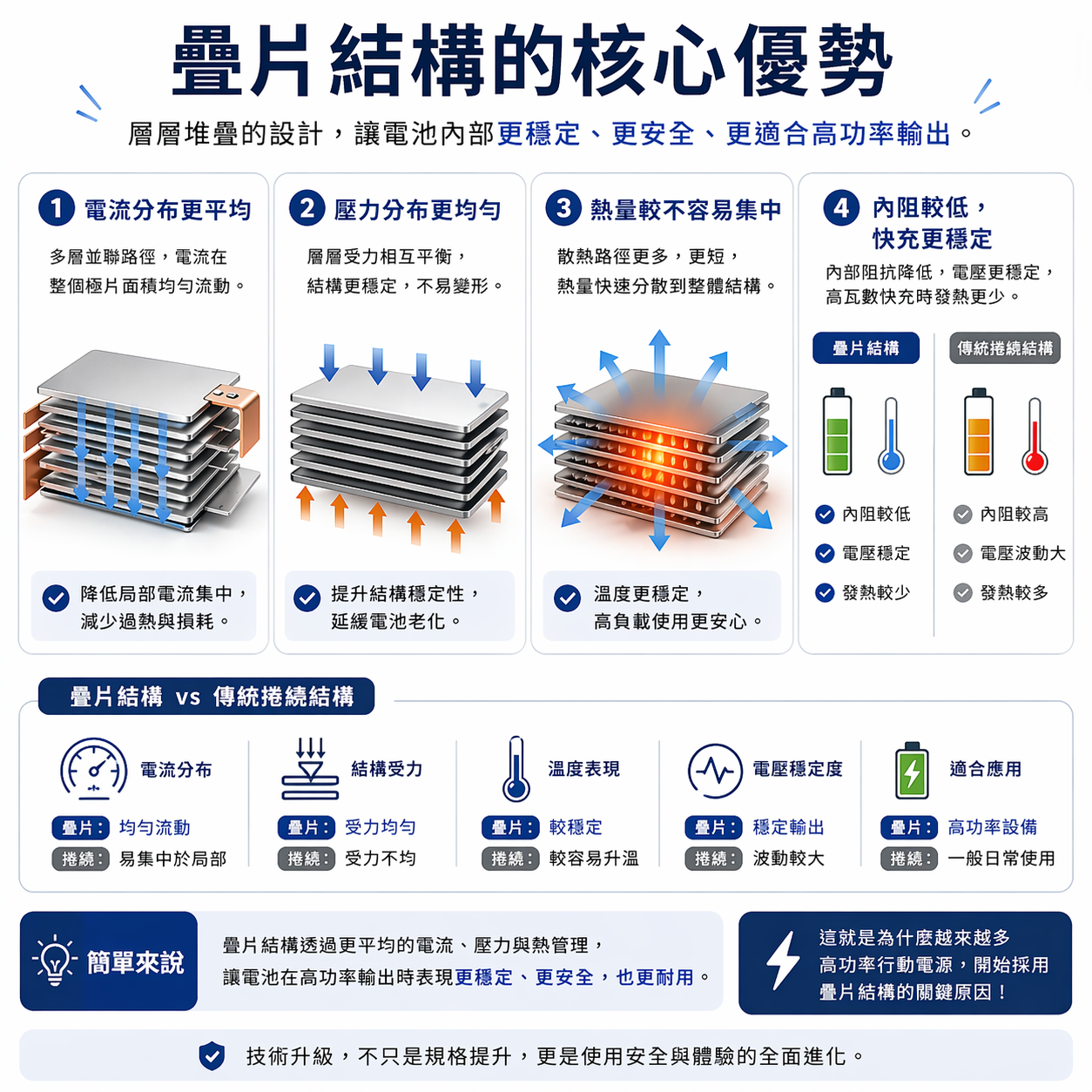
Stacked cells use a different manufacturing process. Instead of rolling the materials into a cylinder, the cathode, anode and separator are laid down one layer at a time, closer to the pages of a book.
The key difference is that mechanical stress, conductivity and heat dissipation are spread far more evenly inside the cell, which is why stacked designs are increasingly used in high-power products.
The core advantages of a stacked structure:
- More even current distribution
- More even pressure distribution
- Heat is less likely to concentrate
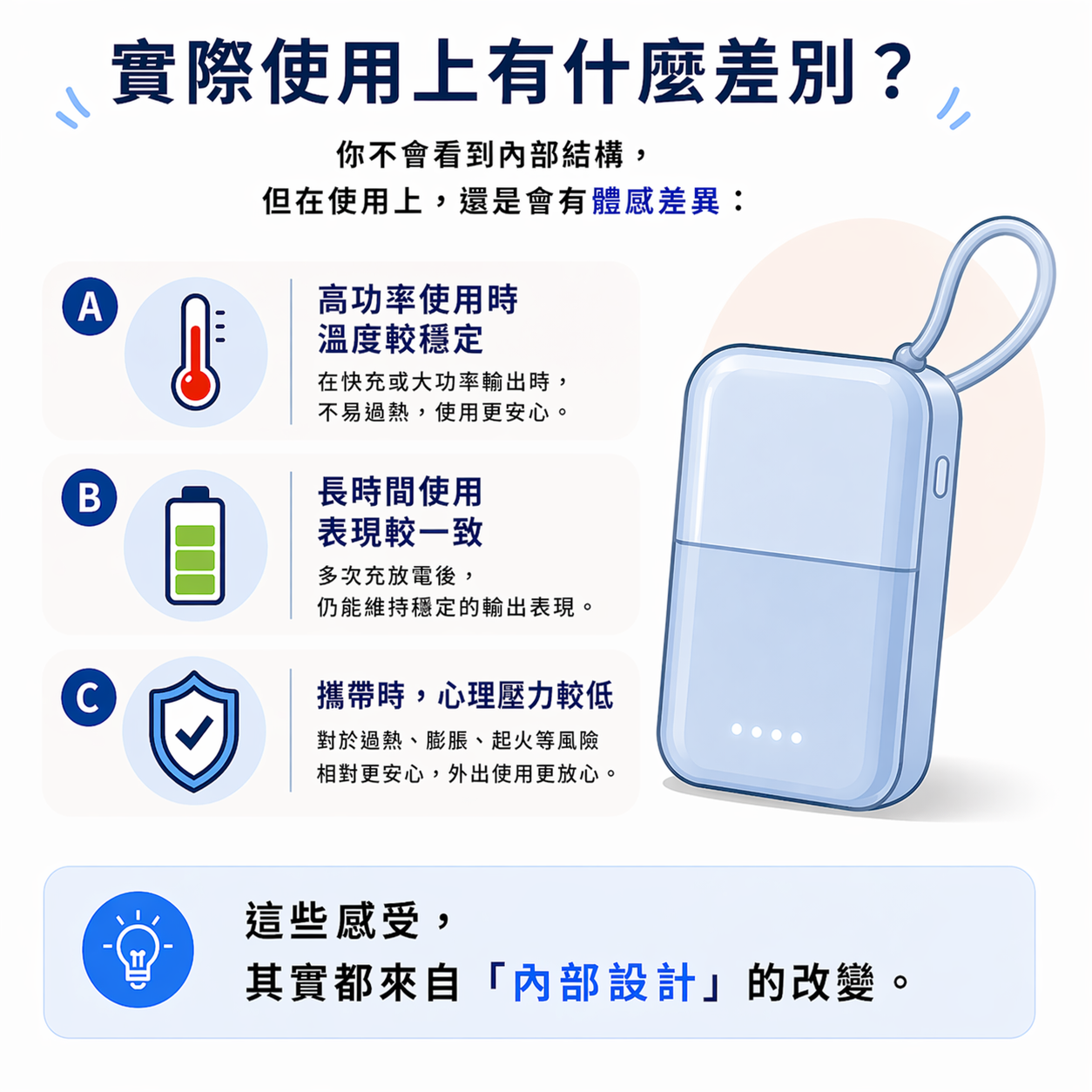
And the point that matters most: stacked cells usually have lower internal resistance, so voltage stays steadier during high-wattage fast charging and the cell runs cooler. That is one of the main reasons high-output power banks have been moving to stacked cells.
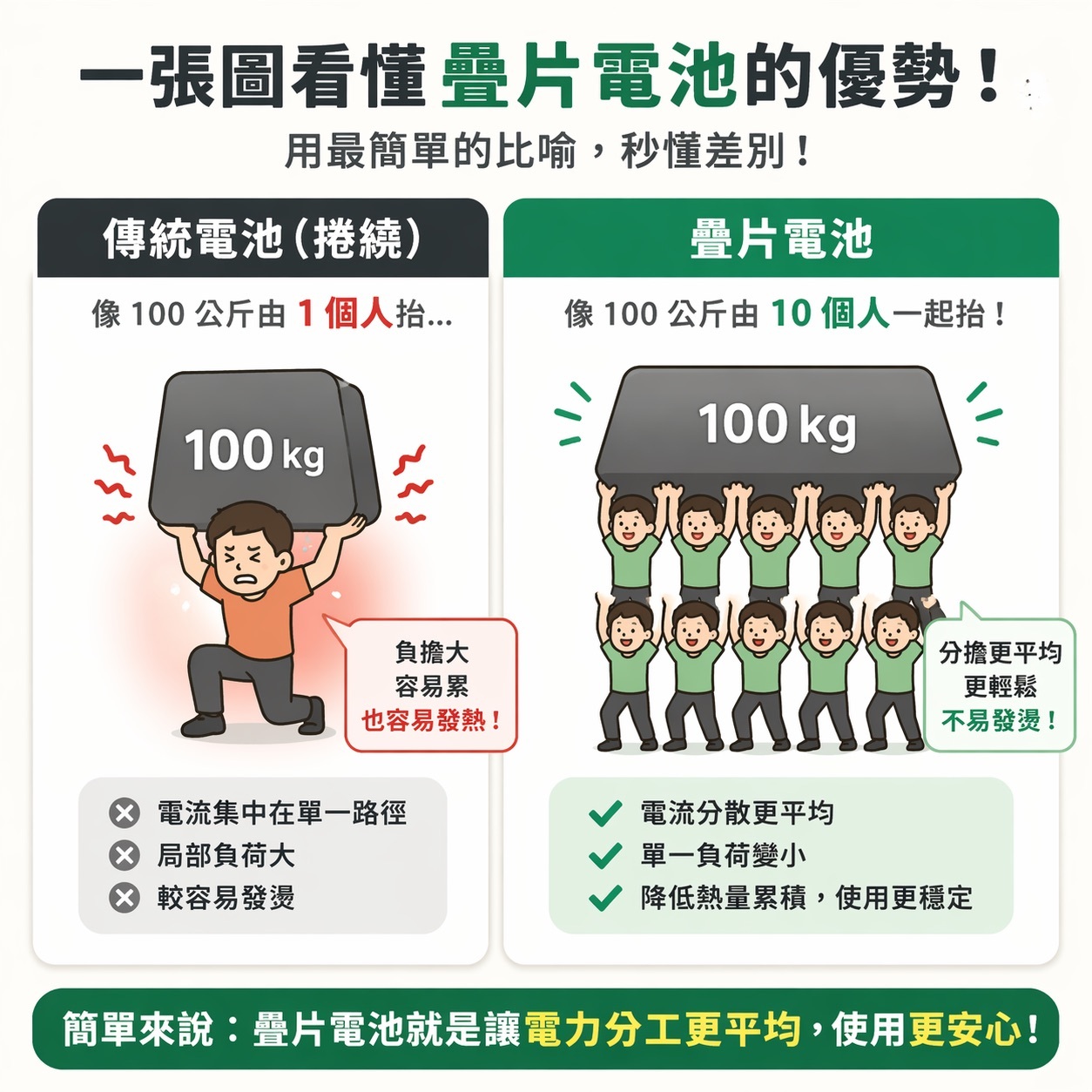
A simple analogy. Imagine the stress a cell takes during charging and discharging as a 100 kg load.
In a wound cell, that load is carried by a relatively small number of concentrated areas, so local stress is noticeable. In a stacked cell the same load is shared across many more layers, so it spreads evenly through the whole cell.
The result is better structural stability, better heat distribution and steadier high-power output.
Wound vs stacked at a glance
| Item | Wound cell | Stacked cell |
|---|
| Structure | Rolled into a cylinder | Layered one on top of another |
| Current distribution | More likely to concentrate locally | More even |
| Heat management | Harder to dissipate from the centre | More evenly distributed |
| Temperature behaviour | Heats up more easily under high load | More stable |
| Space efficiency | Lower | Higher |
| Structural stability | Average | Better |
| Fast-charge performance | Runs hotter at high power | More stable, better efficiency |
| Manufacturing cost | Lower | Higher, but falling |
| Production speed | Faster | Slower, and improving |
In short: wound cells win on cost, stacked cells win on stability and high-power performance.
2. What is a solid-state battery?
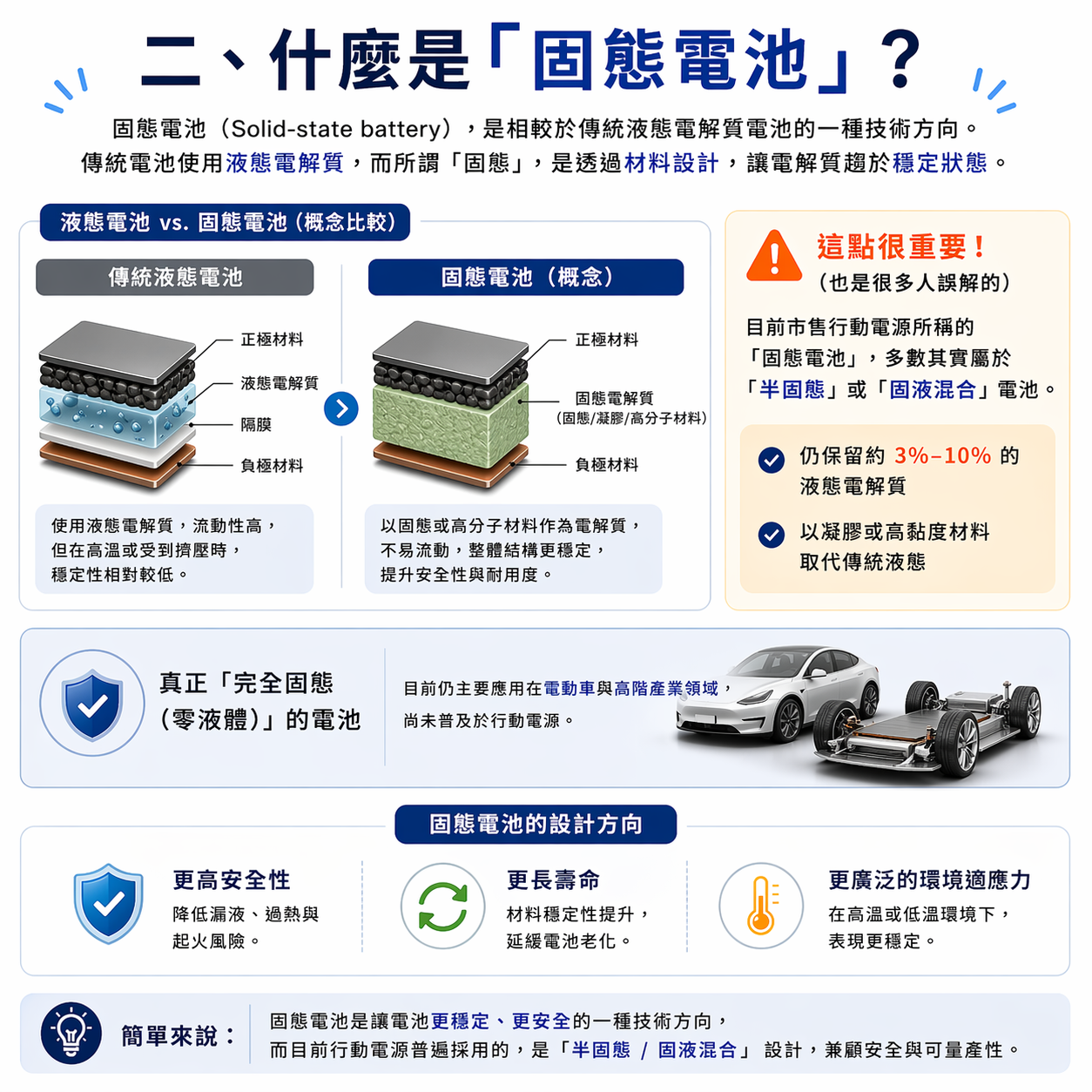
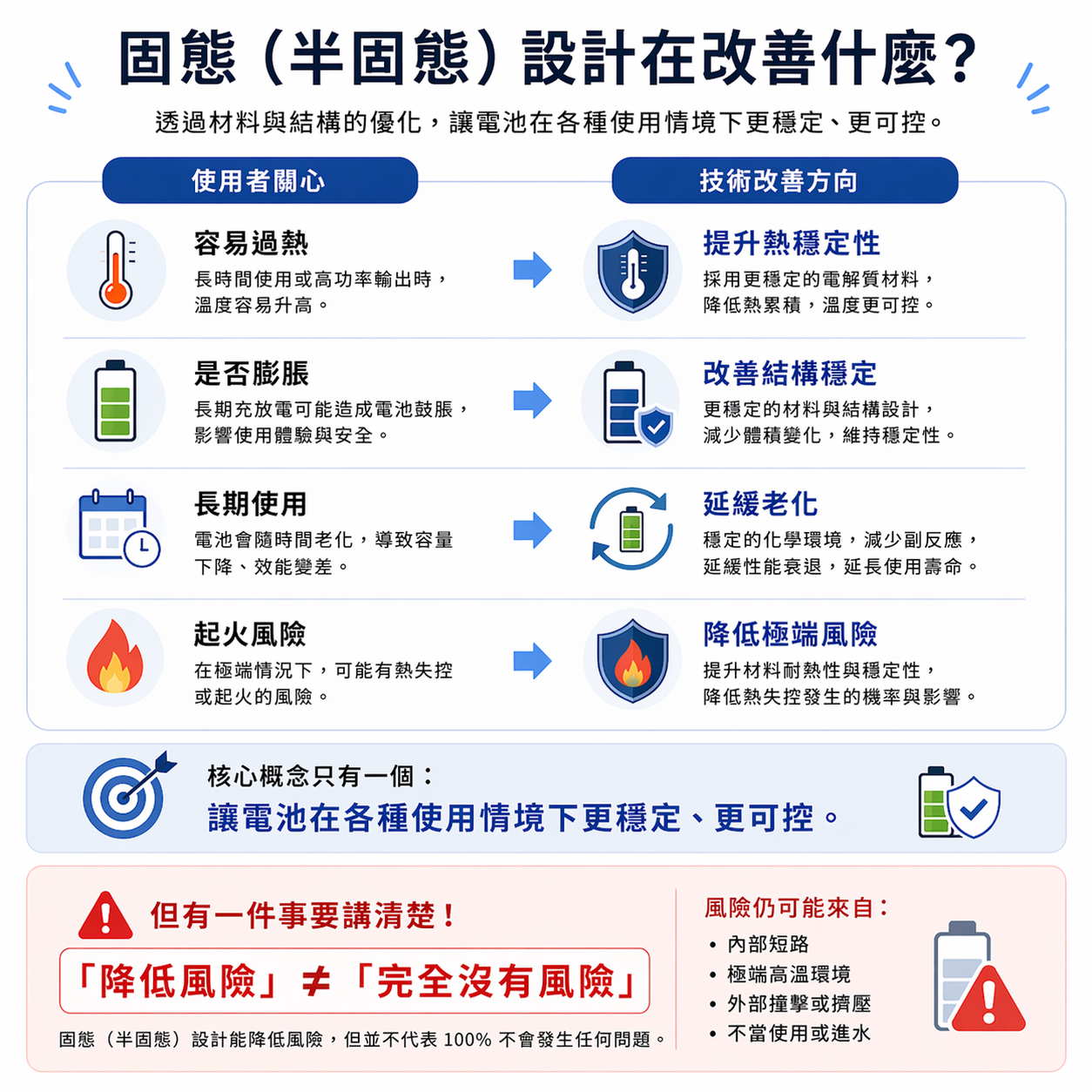
A solid-state battery is an alternative to the conventional liquid-electrolyte cell. Traditional cells use a liquid electrolyte; solid-state means the electrolyte has been engineered towards a stable, solid form.
This next point matters, and it is widely misunderstood. Fully solid-state batteries are still used mainly in electric vehicles and specialist applications. They are not yet common in consumer power banks. What you find on the market today is usually a semi-solid-state design.
What does a solid-state design actually improve?
The aim is more stable, more controllable behaviour across a wider range of conditions:
- Stability under high-power output
- Control under temperature swings
- Consistency over long-term use
- Safety management through charge and discharge cycles
The goal is not to improve a single spec, but to raise the overall experience and the safety margin together.
One important caveat. As long as an electrolyte is present, thermal runaway remains possible under extreme conditions such as an internal short circuit. Real-world safety therefore depends on more than cell chemistry alone:
- The battery management system (BMS)
- Circuit protection design
- The brand's quality control
The technology is the foundation. The overall design is what determines safety.
3. Why stacked plus solid-state is the direction of travel
Put simply: stacked is structural optimisation, solid-state is material optimisation.
Combined, they are less about one headline number and more about a step change in how the cell is designed as a whole. In practice that shows up as steadier current output, better thermal control, and more consistent behaviour in daily use.
So how should you choose?
If you want a power bank that is more stable, more reassuring to carry and suited to high-power charging, a stacked structure with a semi-solid-state design is currently the newer direction.
But keep three checks in mind:
- Has the brand actually tested and verified the solid-state claim?
- Does the product carry the relevant safety certification for your market (in Taiwan, BSMI)?
- Is it covered by product liability insurance?
Related products
Further reading